The Silent Operator
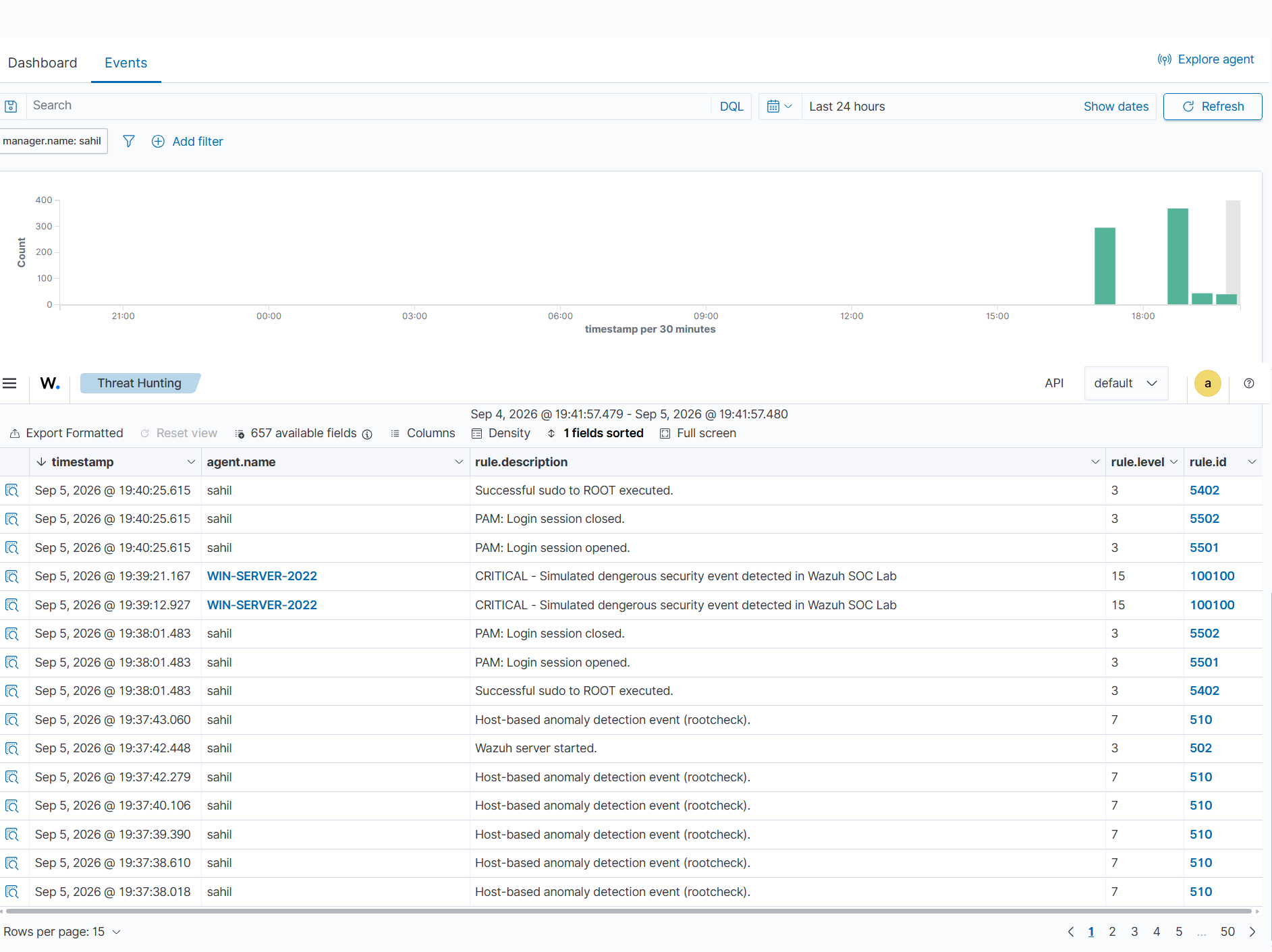
End-to-end SOC lab — Wazuh SIEM, Kali Linux, Windows 10, virtualised hosts — ingesting Sysmon and system logs from multiple endpoints into centralised dashboards. Controlled red-team attacks are executed against it, mapped to MITRE ATT&CK, then hunted from the defender side to find out what the stack missed.
- Wazuh
- Sysmon
- MITRE ATT&CK
- Kali
- Windows 10
- Virtualised lab
objective
Find out whether a detection stack I built myself would actually catch a red-team run — and record honestly where it did not.
environment
- Wazuh SIEM
- Sysmon
- Kali Linux
- Windows 10
- Virtualised lab
- MITRE ATT&CK
approach
- 01Built the lab end to end: Wazuh manager, agents on every endpoint, Sysmon and system logs forwarded into centralised dashboards.
- 02Executed controlled red-team attacks against the lab hosts, one technique at a time.
- 03Mapped each technique to its MITRE ATT&CK ID before running it, so the expected telemetry was written down in advance.
- 04Hunted from the defender side: log correlation, custom alert rules, triage, threat hunting.
outcome
- ›Techniques that fired an alert were recorded with the rule that caught them.
- ›Techniques that produced nothing were recorded as gaps, then closed with new rules and re-run.
how it works
detection logic
<group name="authentication_failures,windows,">
  <!-- 60122 is Wazuh's built-in Windows logon-failure rule. A burst of
       them from one source inside sixty seconds escalates to a brute-force
       alert at level 12 — the version captured firing in the lab. -->
  <rule id="100211" level="12" frequency="5" timeframe="60">
    <if_matched_sid>60122</if_matched_sid>
    <same_source_ip />
    <description>Brute-force attack detected - multiple Windows logon failures</description>
    <mitre><id>T1110</id></mitre>
  </rule>
</group>
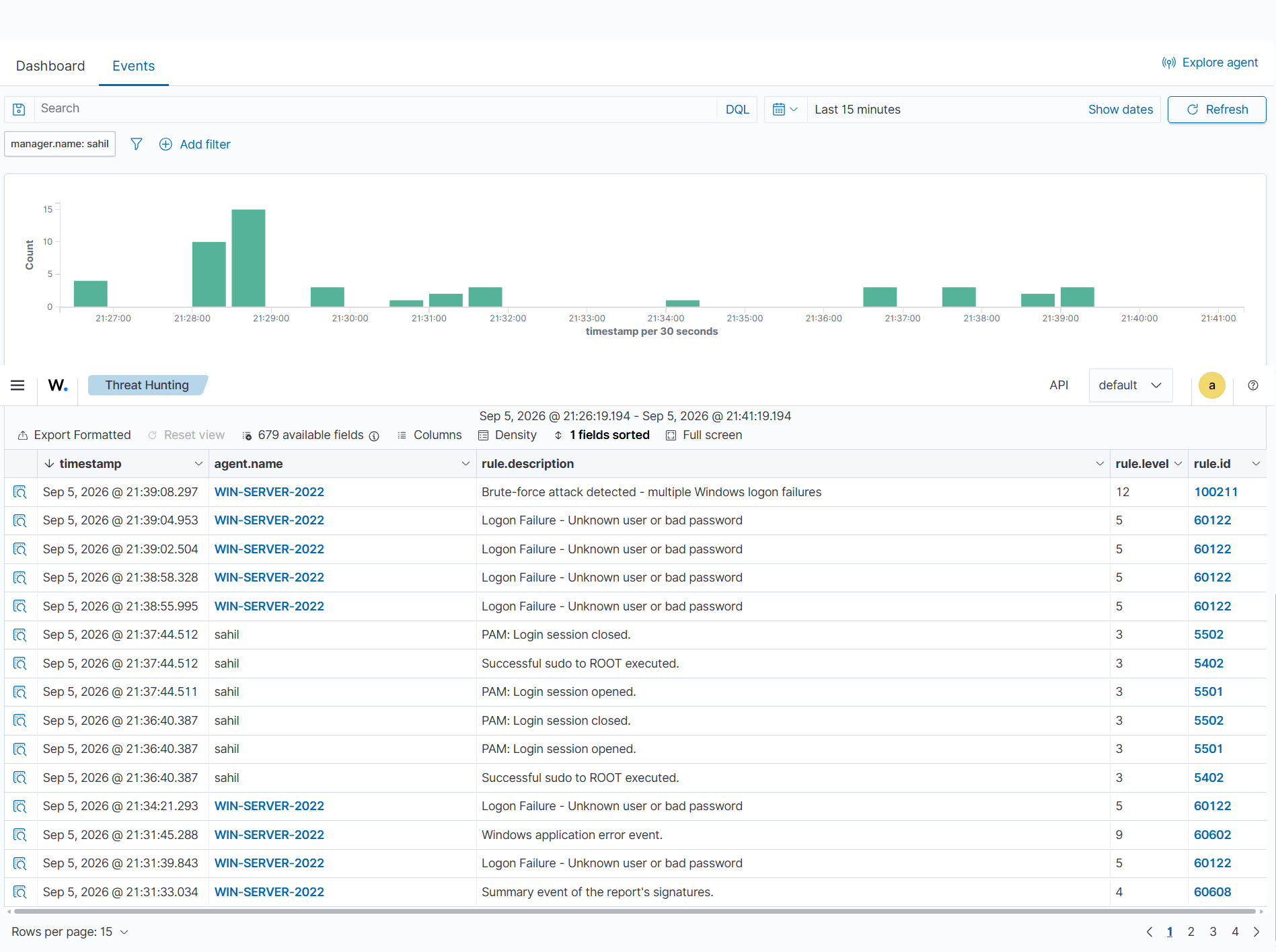
Level 12 and the 60122 base rule are read directly off the capture. The frequency and timeframe come from the lab notes and cannot be confirmed — a dashboard shows what fired, not the rule that fired it, and the lab has been decommissioned; treat those two numbers as a starting point to tune. A three-stage chain (100210 into 100211 into 100212, the last one catching a success straight after the burst) was designed and never validated: neither 100210 nor 100212 appears anywhere in the capture, and it reuses 100211 for a different rule. The repository README carries it, labelled. Captured firing on 5 Sep 2026 (see the artifact above): four level-5 60122 logon failures on WIN-SERVER-2022, then rule 100211 at level 12. The same capture also shows isolated 60122 events at 21:34 and 21:31 that raised nothing — a correlation rule is only worth having if it stays quiet on the noise, and that is the half usually left out of a screenshot. Tune the frequency before trusting it — five in sixty seconds is what the deployed rule uses, not a measurement. False positives: service accounts with stale cached credentials and password managers retrying after a change.
title: Windows brute force followed by success
id: 0f1b2c3d-4e5f-6071-8293-a4b5c6d7e8f9
status: experimental
description: Repeated 4625 failures from one source, then a 4624 success
logsource:
  product: windows
  service: security
detection:
  failures:
    EventID: 4625
  success:
    EventID: 4624
  timeframe: 2m
  condition: failures | count() by IpAddress > 5 and success
falsepositives:
  - Service accounts with stale cached credentials
  - Password managers retrying after a change
level: high
tags:
  - attack.credential_access
  - attack.t1110
Sigma keeps the logic portable: the same reasoning moves to Splunk or Elastic without being rewritten.
artifacts
highlights
- $Simulated attacks mapped technique-by-technique to ATT&CK
- $Detected via log correlation, custom alert rules, triage and threat hunting
- $Exposed detection gaps, then closed them with new rules
scope
Every technique referenced here was executed inside authorised environments — my own virtualised lab hosts, DVWA, and systems I was engaged to assess. Attack simulation is always paired with the detection or hardening that answers it: that pairing is the whole point of the work, not a disclaimer on it.